When you're building a LinkedIn Ads campaign (or any campaign in your paid media lineup), it's tempting to focus on the immediate decisions: targeting, creative, budget, bidding, and launch dates.
But there's another decision we take seriously at Nephila: what to name the campaign.
At Nephila, everything is in the name.
We use detailed, consistent naming conventions because we know we'll eventually need to answer questions that go well beyond how an individual campaign performed.
Which regions are producing the most leads? Which types of assets are working? Are static image ads outperforming document ads? How do ABM audiences compare with broader targeting? Which promotions are generating qualified leads?
If the account is organized properly from the beginning, answering those questions becomes much easier.
Start with the questions you'll need to answer
We approach campaign organization with reporting in mind.
Before building a campaign, we consider how the client will need to evaluate performance across programs, regions, audiences, content assets, and ad formats.
That informs both the campaign hierarchy and the naming taxonomy.
Here's an example of a LinkedIn Ads campaign name using Nephila's approach:
NA_LADS_LEADGEN_SPONSORED_STATIC_IMG_ABM+TITLE_EBOOK_EBOOKNAME
It may look long, but every component serves a purpose.
| Component | What it tells us |
|---|---|
| NA | North America |
| LADS | LinkedIn Ads |
| LEADGEN | Lead generation objective |
| SPONSORED | Sponsored advertising |
| STATIC_IMG | Static image creative |
| ABM+TITLE | Account-based targeting combined with job titles |
| EBOOK | Content asset type |
| EBOOKNAME | The specific ebook being promoted |
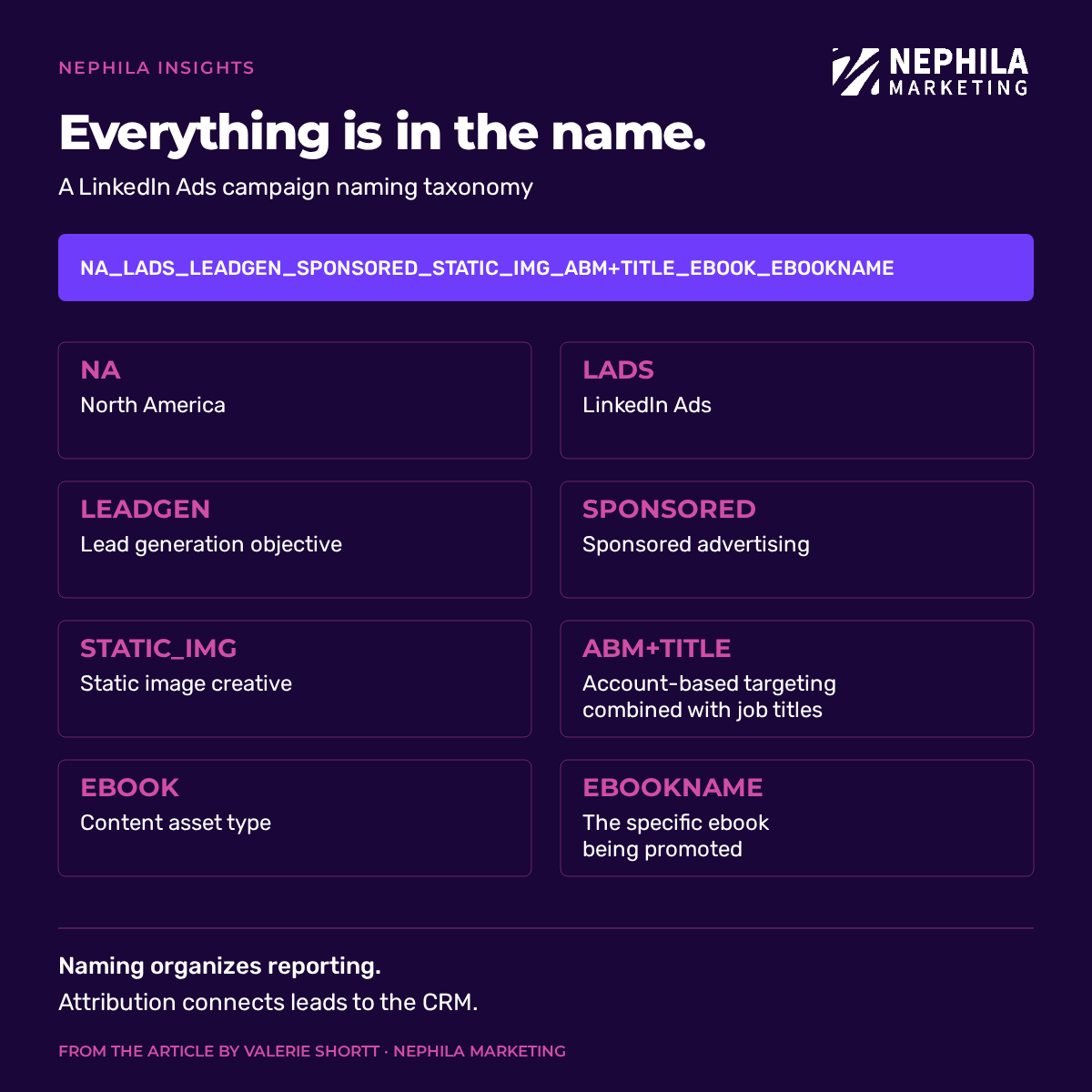
In this example, we're running a static image ad on LinkedIn, targeting a defined account list and job titles in North America. The ad promotes an ebook through a landing page with a form, with the goal of generating leads.
The name captures the important dimensions of that campaign without requiring someone to open LinkedIn Campaign Manager to figure out what it does.
Why the naming convention matters after launch
The real value appears when we start aggregating performance.
Because campaigns use consistent naming conventions, our reporting system can identify and group them according to meaningful dimensions.
We can roll up performance across multiple campaigns to answer questions such as:
- How much are we spending in North America compared with Europe?
- What's our cost per lead by asset type?
- How are static image ads performing compared with other formats?
- Which ABM audiences are generating engagement and leads?
- Which ebooks are performing best across different campaigns?
Instead of manually organizing campaigns into reporting categories every month, the taxonomy provides a consistent framework for grouping the data.
The campaign name becomes part of the reporting infrastructure.
Naming and attribution are two different things
There's an important distinction between organizing campaign performance and attributing individual leads to the appropriate marketing campaign in Salesforce.
Our naming conventions help us categorize and aggregate performance data. But they don't automatically associate a lead with the correct Salesforce campaign.
For that, we work directly with the client's Salesforce administrator and marketing operations team to establish the appropriate tracking method.
Depending on the client's systems, that may involve UTM parameters, campaign identifiers, hidden form fields, HubSpot workflows, or another agreed-upon method for associating leads and contacts with Salesforce campaigns.
The objective is to ensure that when a lead converts, the appropriate marketing campaign receives credit in the CRM—not simply that the conversion appears in LinkedIn Ads.
We establish and test that process before launch.
Good campaign naming helps us understand performance. Proper attribution connects that performance to the CRM. Both matter.
The same discipline applies to HubSpot forms
Campaign names aren't the only names that matter.
HubSpot form naming deserves the same attention, particularly when forms are being created across multiple campaigns, assets, business units, and regions.
We recommend establishing a consistent form taxonomy from the beginning—one that can scale as the marketing program grows.
For example:
NA_EBOOK_ApplicationSecurityGuide_DOWNLOAD
This tells us the region, asset type, specific resource, and form purpose.
Compare that with a form named `Download Form 7`.
Both might function perfectly well, but only one provides useful context when you're reviewing contact records or building reports.
HubSpot contact properties such as First conversion and Recent conversion can make descriptive form names especially valuable.
First conversion identifies the contact's first recorded form conversion, while Recent conversion identifies the latest conversion, with information that includes the page title and form name.
A consistent taxonomy makes it easier to interpret these properties and build meaningful contact segments.
For comprehensive asset reporting, we also examine form submission activity rather than relying exclusively on first and recent conversion properties.
The test: Can someone understand your naming system without a map?
A naming convention shouldn't require a lengthy explanation every time someone new joins the team.
We document our taxonomies, but we also believe the structure itself should be intuitive.
If a new campaign manager, marketing operations specialist, or client stakeholder opens the account without a naming guide, can they reasonably understand what they're looking at?
Can they identify the campaign's purpose, audience, region, and promoted asset?
Can they find related campaigns?
Can they recognize when something has been named incorrectly?
And can the structure accommodate new asset types, regions, or campaigns without being redesigned?
A good taxonomy is consistent enough for reporting, descriptive enough for people, and flexible enough to grow.
That applies to LinkedIn Ads campaigns, HubSpot forms, landing pages, tracking parameters, and the other components of a demand generation program.
Build the reporting structure before you need the report
Campaign organization is much easier to establish at the beginning than to reconstruct after dozens—or hundreds—of campaigns have launched.
Our approach is to define the naming taxonomy, campaign hierarchy, tracking parameters, and reporting requirements together.
We also coordinate with the client's marketing operations and Salesforce teams so campaign-level reporting and CRM attribution work together.
That way, campaign managers have a consistent structure to follow, marketing operations can connect the data, and leadership can evaluate performance across the dimensions that matter.
It's a relatively small operational discipline that makes a significant difference as programs grow.
Because when you build campaigns for reporting from day one, you spend less time organizing the data and more time understanding what it's telling you.
LinkedIn Ads Campaign Naming & Reporting Checklist
Before launching your next campaign, confirm:
☐ We've defined the reporting dimensions that matter to the business.
☐ Campaign names identify the appropriate region, platform, objective, format, audience, asset type, and promotion.
☐ Abbreviations and naming rules are documented and consistent.
☐ Campaign groups support the budget and program structure.
☐ Our reporting system can reliably interpret campaign names.
☐ UTMs and tracking parameters align with the reporting framework.
☐ We've coordinated with the Salesforce administrator or CRM owner to confirm campaign attribution requirements.
☐ We've tested that conversions are associated with the intended Salesforce campaign.
☐ HubSpot forms follow a consistent, scalable naming taxonomy.
☐ Form names provide meaningful context in conversion properties and reporting.
☐ Someone unfamiliar with the account can understand the naming structure.
☐ The taxonomy can accommodate future campaigns, assets, and regions without major changes.
The takeaway: Name campaigns for the reporting you'll need tomorrow—not just the launch you're managing today.